The other half
AI safety, as most people practice it, points at the model. Make it do what it's told and nothing else. Look inside it to see how it works. Test its output to make sure it's doing what it's supposed to.
There's a second half that gets far less attention. The person on the other side of the screen has to comply too. Are they reading the output? Do they understand it? Are they checking it, or going along with it?
Call that cognitive safety. It's the same three jobs, pointed at the human: get the person to engage with the model's output, understand what's going on inside them while they do, and check that they're doing their part. And just as researchers pry models open to see what's happening inside, we can look inside people, through their behavior and, more interestingly, through brain imaging.
Why now
In September the OECD released PISA 2025, its global test of 15-year-olds. Average reading and math scores were the lowest PISA has ever recorded. Reading alone has dropped 28 points across OECD countries since 2015, about a year and a half of learning.
The same survey asked about AI. 46% of students use AI chatbots at least weekly. For specific schoolwork tasks, students who didn't use AI outscored students who did by about 20 points in science, roughly a year of school. For summarizing what they read, daily users scored almost 30 points lower.
Those are correlations. Students who are already struggling may simply lean on AI more. But two details stand out. For one use, the pattern flipped: students who used AI about once a week to help them learn scored higher than both non-users and daily users. And among frequent users, the ones who had been taught to judge the quality of AI-generated information did better than the ones who hadn't. How students use it seems to matter more than whether.
College is further along. In a student newspaper survey at MIT, nearly half of undergraduates said they use AI chatbots every day, and about two-thirds said they were very concerned about relying on them too much. In the UK, 95% of undergraduates now use AI, and 94% use it on work that gets graded.
What it looks like in the brain
The closest anyone has come to measuring this directly is a 2025 MIT Media Lab study called Your Brain on ChatGPT. Fifty-four people wrote essays using ChatGPT, a search engine, or nothing, while wearing EEG caps. The ChatGPT group showed the weakest connections between brain regions, had trouble quoting essays they had just written, and felt the least ownership of their work.
It's a small, early study, and it's been argued over. But its limit is where the interesting question starts. It shows that writing with AI looks different in the brain. It can't show why.
Three people, one click
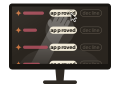
Here's one experiment that gets at the why. Most AI tools end the same way: the model writes the email, the code or the summary, and a person clicks accept. That click is the "human in the loop." It records that someone agreed. It doesn't record whether they read the answer, checked it, or understood it.
Picture three people clicking the same button:
- One read the answer, understood it, and judged it correct.
- One didn't really check.
- One tried to check and couldn't follow it.
From the outside they look identical. They need different fixes. The first is fine. The second needs something that makes them actually look. The third needs a better explanation, and telling them to try harder won't help. So the question is whether anything can tell them apart while it's happening.
A few recent experiments suggest the brain might.
- People watched a partner sort pictures of dogs and cats. Some were told the partner was a person, others that it was an automated system, and its performance was identical either way. In the "person" group, the partner's mistakes triggered a frontal response called the P3a, the brain's "wait, what?" signal. In the "system" group, it was completely absent. The authors suggest the missing signal could be a marker of automation complacency. (Rogers et al., 2026)
- People searched a screen for a target alongside an AI partner that was either 95% or 75% accurate. An EEG marker of focused attention shrank with the reliable partner and stayed large with the unreliable one, as if people were quietly handing part of the search over. (Wiese and Feldmann-Wüstefeld, 2026)
- In a small MIT study, EEG plus eye tracking caught when readers were confused about three times out of four. (Zhuang et al., 2025)
None of these come from real AI use. Sorting cats and dogs is far from reading an AI's explanation of your code. But together they suggest the question can be answered: can brain signals tell "didn't check" apart from "couldn't understand"?
Why this isn't chess
In 1997 a computer beat the world chess champion, and people kept playing anyway. The point of chess was never the best move. It was the game.
Most of what we're handing to AI doesn't work like that. In drug discovery, surgery or running a power plant, the result is the whole point. Even if a model is provably better at the job, someone is still responsible for the decision, and that person can't be a spectator. They have to stay the one who decides.
Europe has already written this into law. The EU AI Act requires high-risk AI systems to be "effectively overseen by natural persons," and tells those people to watch out for "automation bias," the habit of over-relying on a machine's output. But nothing measures whether that oversight is real. On paper, someone who approves a thousand outputs a day without reading them is still a human in the loop.
A field in the making
The pieces are showing up all at once. The OECD's own data shows students who were taught to judge AI output doing better. Neuroscientists are measuring what AI does to writing. AI safety researchers have a name for the slow, society-wide version of the problem, gradual disempowerment: people losing their grip on the systems they depend on, without any single dramatic moment. And in May, Jacob Steinhardt argued that cognitive security, "the ability of humans to maintain control over their beliefs and actions," should be an AI safety cause area of its own.
I'd put cognitive security inside cognitive safety rather than next to it. Keeping control of your beliefs is the goal. The field also has to ask how you'd measure that, which parts of a person's thinking matter most to keep, and how to keep changing your mind when the AI is right. Protecting your beliefs from a persuasive machine is half the problem. Updating them when the machine is correct is the other half. Someone who never changes their mind isn't safe. They're just hard to persuade.
Both sides of the glass
Here's the deeper version. Interpretability research is about getting a model to show its internal state to the outside world: what it's representing, why it answered the way it did. Cognitive safety is about getting a person to show theirs: whether they understood, whether they checked. Put them together and AI safety becomes a question about a conversation between two systems whose insides are hard to see.
You can watch it fail in both directions in an ordinary chat. When I type "sure," the model can't tell whether I checked its answer or gave in. When it says "you're absolutely right," I can't tell whether it weighed my claim or mirrored it. Both sides get agreement without seeing how it was reached. A model that explains itself to someone who isn't listening has gained nothing, and a careful person checking a model that hides its reasoning can't check much.
Between two people, none of this is hard. Talk to someone face to face and you can tell, to a surprising degree, whether they're engaging with what you're saying, not listening at all, or trying to follow and getting lost. It's in their body language, their tone of voice, their pauses, whether they meet your eyes, and it works so seamlessly that we hardly notice it. Those are the same three people behind the click. A chat window strips all of that away and leaves "sure." Cognitive safety is trying to model that same signal, but for conversations between people and AI.
Safety is what you get when both sides can show their work. Cognitive safety is the half of that picture that's still missing.